
-01.png)

Afterthoughts… Beyond the Training Room: How the Think-Feel-Behave Framework Drives Lasting Change with Jenny Barkan
Updated: Feb 17
Approximately 10% of behavioural change from training remains after three months. We invest so much time, money, and energy in designing, developing, and facilitating the training, yet the numbers are low. How can we increase it?

First, test yourself! Are the following statements myths or facts?
We remember 10% of what we read, 20% of what we hear, 30% of what we see, and 90% of what we do.
Learning styles (e.g. auditory, kinesthetic, visual) should guide what we do in training.
If people understand why change matters, they will change their behaviour.
If a training is engaging enough, behaviour change will follow.
It might surprise you to learn that all of these are actually myths. So, if these statements are not true and should not influence our training in the way we thought they should, what do we do instead?
Fact: What we remember the most depends on the level of cognitive effort put into learning it, emotional importance, and retrieval practice.
Fact: The brain is multimodal by default. We need to be engaged in a variety of ways to encourage learning to ‘stick’.
Fact: Understanding a change does not equal behavioural rewiring. We need to engage both the ‘thinking brain’ (prefrontal cortex) and the ‘feeling brain’ (limbic system) to influence behavioural change.
Fact: What helps to change behaviour includes the expectation of safety, the belief that there will be a reward, and the emotional permission to act differently.
Fact: What predicts learning transfer includes a leader and/or manager’s support of the learning, and if related systems align with expected behavioural change.
A helpful model to think about how we can drive lasting change in our training is the cognitive triangle.

Thinking influences feeling, which influences behaviour, which leads to different results in a given situation. This learning and education happens within a larger system in the workplace. Of course, let’s not forget that humans are also a system. As humans, we experience interactions between our emotional state, existing beliefs, core values, worldview, understanding of self, and more.
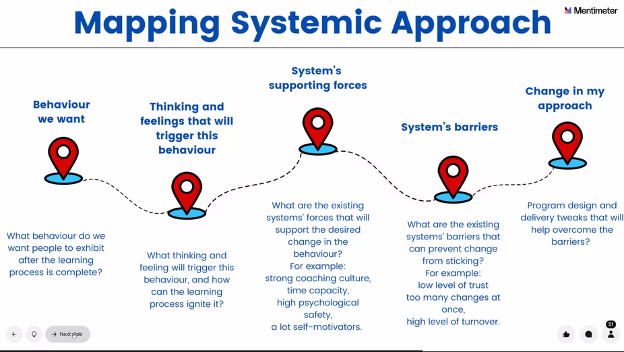
A helpful approach to designing training, then, is a systems approach that incorporates the cognitive triangle (thinking, feeling, behaviour). This is outlined in the diagram below.
After attending the session, would you like to learn more? Check out the following resources!
Ditch the myth of learning styles and use The Universal Design for Learning (UDL) Framework instead - https://www.cast.org/what-we-do/universal-design-for-learning/
Learn more about emotions in learning and how you can support their critical role - https://atl.web.baylor.edu/teaching-guides/considering-students/emotions-learning
Dig deeper into two effective, impactful learning strategies: spacing and retrieval practice - https://youtu.be/Vn4qTwt1x2E?si=A0fIba1Dd5EW1Wcd
Link to the presentation - https://bit.ly/CCCEFeb26


Comments